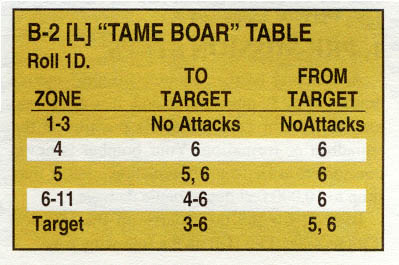
The Fifth Campaign uses a 1945 Target List. Because approprate targets depend strongly on the progress of Allied advance, a table of random targets is not practical. Targets were chosen from a historical list, with a goal of having a mix of target types and zones. These lists are available in letter or A4 format.
There are three issues that may, optionally, be addressed after the time period of the Battle of Berlin covered by the standard Lancaster Variant rules. They are the Schräge Musik oblique cannon installation, more advanced German aircraft, and fewer German aircraft.
- German Aircraft
-
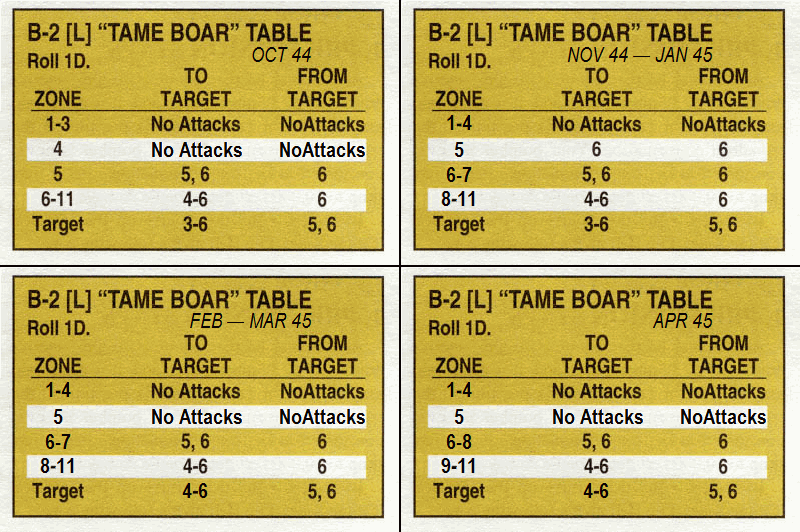
Tame Boars: The frequency of Tame Boar attacks should be reduced
begining in October 1944. Modify Table B-2[L] as outlined in Magnus Kimura's Friday the 13th Campaign.
-
Ju-88's continued to replace Me-110's in the Nachtjagd through the period of the Fifth Campaign.
If a Tame Boar attack is indicated by the original or
modified
Tame Boar
table B-2[L], roll 1D:- 1–3 = Tame Boar is a Me-110.
- 4–6 = Tame Boar is a Ju-88.
Tame Boar
table. Use the colored die to determine whether a Tame Boar will attack. If there is a Tame Boar attack, the white die will determine whether it is a Me-110 or a Ju-88 according to the table above. -
Rules 4–6 from Bruce Peckham's Ju-88C-6 heavy (day) fighter
rules may be adapted for use at night:
- The Ju-88 inflicts additional damage to the Lancaster (all hits are +1 hit).
- The Tail Guns need a die roll of 4–6 to hit the attacking Ju-88. If bomber is taking evasive action, all defensive fire from the bomber needs a die roll of 5–6 to hit the attacking Ju-88.
-
Lancaster twin mount MG hits on the Ju-88 fired by a non-ace gunner are reduced
one level: FCA = no damage; FBOA = FCA; Kill = FBOA. Regardless of the die roll
a twin mount MG fired by a non-ace gunner cannot kill a Ju-88 with one hit. The
max damage is FBOA. An ace Lancaster gunner is an exception. Ace gunner results
are treated normally, even if the ace is firing a twin mount MG. The quad Tail
Guns fired by a non-ace gunner are treated normally only if all four are
operational. The quad Tail Guns fired by a ace gunner are always treated
normally. (Note that
normally
for the quad Tail guns means there is the usual +1 modifier on Table M-2.) See a simplification.
-
Wild Boars: The dedicated Wild Boar units were disbanded or
converted to all-weather day fighting in March 1944 due to heavy losses (landing
accidents, etc.). Single-engined fighters did, however, continue to be used in
the Wild Boar role. If a Wild Boar attack is indicated by rule 4.B of the standard
Lancaster Variant rules, roll 1D:
- 1–3 = there is no Wild Boar.
- 4 = Wild Boar is a Me-109.
- 5–6 = Wild Boar is a FW-190.
Wild Boar
attack. Use the colored die according to rule 4.B. If a roll of6
indicates a Wild Boar attack, the white die can be compared to the table above. - Schräge Musik
- Magnus Kimura has included rules for Schräge Musik at the end of his Corkscrew Port rules.
-
Alternatively, note that because Schräge Musik can only be used when
a Tame Boar achieves surprise, the Spotting Roll (Rule 3.C.i) can also serve to
determine whether the Tame Boar is equipped with Schräge Musik. For
the Fifth Campaign, I suggest:
- 1–2 = Tame Boar spotted by Tail Gunner.
- 3–4 = Tame Boar approaches unseen.
- 5–6 = Tame Boar approaches unseen, equipped with Schräge Musik.
- Ju-88's may be equipped with Schräge Musik.
-
For those who do not wish to use the Corkscrew Port rules for Schräge Musik once
it has been determined that a Tame Boar is so equipped, these simple rules are
offered: Treat the Tame Boar exactly according to the standard Lancaster Variant
rules except for the determination of hit locations (3.D.vii). For the hit
locations, roll 1D and all hits are on the:
- 1–3 = Port Wing.
- 4–6 = Starboard Wing.
- Operation Gisela
-
Conducted on the night of 3/4 March 1945, Operation
Gisela was the Luftwaffe's attempt to deliver a knock-out blow to Bomber Command by engaging
the heavy bombers where they must eventually appear, over British bases, rather than searching
for them through the skies of Germany. Although great confusion was caused at the airfields, and
20 Bomber Command aircraft were lost, at this stage of the war it was
too little, too late
. - Note that only Ju-88s had the fuel capacity to loiter over Bomber Command bases.
-
When arriving in Zone 1 (England), roll 1D to check for an attack during normal flight.
- 1–5 = No attack.
- 6 = Ju-88 conducts a Tame Boar attack.
-
Just before landing, roll 1D to check for an event over the airfield.
- Normal landing.
- Airfield lights out. -2 to Land on Table G-9, or abort* to alternate landing field.
- Airfield obstructed by vehicles, debris, etc. -4 to Land on Table G-9, or abort* to alternate landing field.
- "Friendy" ground fire. Roll once on Light Flak Table O-3 and abort* to alternate landing field, or roll three times and land.
- "Friendy" fire. Treat as Me-109 attack. No return fire. Abort* to alternate landing field after Initial Attack, or accept two Subsequent Attacks from same position and land.
- Ju-88 modified Tame Boar attack. No Schräge Musik. No evasive action in Initial Attack. Abort* to alternate landing field to conduct evasive action in Subsequent Attacks, or accept two Subsequent Attacks without evasive action and land.
- * Aircraft with fuel leaks may not choose to abort to an alternate landing field. Other aircraft may only abort to an alternate landing field only once. At the alternate landing field, roll 1D to check for another event.
- If damage forces a Controlled Bail Out over the airfield, -1 to Bail Out on Table G-6 (first roll). No Uncontolled Bail Out permitted (Table G-7) over airfield.